Saturday, April 14, 2012

In Which Campus Building do BYU Students Pray the most?

There is a joke on BYU campus that I heard several times while I studied there.  There are a few variants, but the gist of it is "In which campus building do BYU students pray the most?".  The answer is the Grant Building.  If you don't get it, don't worry, I didn't either the first time I heard it (mainly because I didn't know which building was the Grant Building).  The Grant Building is one of the busiest building on campus, but it is better know as the testing center.  It is the largest college testing center in the United States and the location where BYU students take almost all of their tests while at college (hence all of the praying).

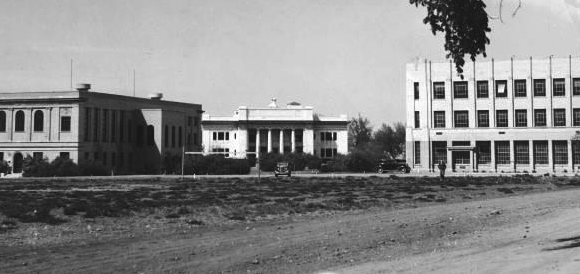
I mentioned the grant building during the last post about the Brimhall Building.  The Grant Building is the building on the left in the picture of the Brimhall and the Maeser Building.  Here is an additional picture of it from 1925 and what it looks like today:

Courtesy of the L. Tom Perry Special Collections, Brigham Young University


The Grant Building, built in 1925, was originally a library.  There is an interesting history on Wikipedia about the history of the Harold B Lee Library (the current library at BYU) which includes a bit of the history of the Grant Building.  Here is what it says:

"The Harold B Lee Library began as a small collection of books kept in the office of Karl G. Maeser during his time as principal of then Brigham Young Academy.  The small library relied almost exclusively on gifts, donations, and free material from the U.S. Government.  When Maeser's office was destroyed by a fire in 1884, his library collection went with it.  By the time the Education Building was completed in 1892, a new library had been formed and a room was provided on the second floor of the new building.

"The academy later became a university, which spurred the library's growth until it filled the third floor and much of the second floor of the Education building.  In July 1924, the alumni association reported that $125,000 had been appropriated to construct a new library building to be erected on University Hill.  The new Heber J. Grant Library was subsequently dedicated on October 15, 1925 with 40,000 books and 35,000 pamphlets."

The Grant Building is somewhat small, with the first floor consisting mostly of classrooms and the second floor being a large open room (now the testing center) where the library was located.  By the 50s, the the library had outgrown itself and several little libraries were created in buildings across campus to accommodate the growing number of books.  In 1961, the J. Reuben Clark Library (which is now named the Harold B. Lee Library) was finished, which moved the library from the Grant building.

Besides being a library, the Grant Building has had several different uses.  After the library moved, it was a museum by the College of Biology and Agriculture, until it was moved to the Monte L. Bean Life Science Museum (which is really cool and kind of creepy because it is filled with thousands of dead, stuffed animals, including a liger named Sheba).  For a while, the building housed the BYU Honors Program and was the first location of the BYU Faculty Center.  Currently it is home to the testing center, the Religious Studies Center and a few classrooms.  I have to say that I love the testing center.  Essentially a test is given during a specific time period.  It allows students to take the test anytime during that time period, whenever it is most convenient for them.  The actual room where students take tests is quite pretty and I really enjoyed sitting, relaxing, and looking at the architecture once I had finished a test.

For all you gentlemen that get five o'clock shadows or ladies that like to wear jeggings, the testing center can be a very stressful place because it was the primary place where the honor code was enforced.  When I started at BYU, if you were not clean shaven you were required to leave and come back when you had shaved.  It always created quite a bit of controversy.  However, a few years ago it became a National Testing Center (which means it could administer standardized tests for individuals who were not BYU students) and as a result the honor code was not enforced as strongly as it was in the past.  Currently there is just a sign and you may get a few dirty looks and a "please shave next time."

I have really enjoyed researching the buildings on BYU because there is so much interesting information that I have found on the internet about them.  Here is a bunch of extra stuff that I found about the Grant Building.  First of all, some people claim that the building is haunted.  For a nice scary story about the Grant Building, click here.  I found an interesting website with flashcards for the different building name abbreviations around campus.  If you are looking to memorize them, then click here.  Also, someone went around and took pictures of letters that are found around BYU campus in the different buildings (it actually is pretty well done).  The letters A, G, J, and O were all found at the Grant Building.  You can see all of the letters by clicking here.

Finally, I came across a interesting group of pictures of BYU, including one of the Grant Building.  I am not in love with them because they are extremely photoshopped and very saturated with color, but I'm sure that some will enjoy.  The individual that took the pictures claimed that he did so to highlight the interesting architecture around campus, which is funny because I feel like architecturally BYU is a very dull campus except for a couple of buildings (the Grant Building being one of those).  You can see the collection by clicking here.

Thursday, April 12, 2012

BYU Presidents

Continuing on with the segment on BYU, I was going to try to cover three buildings today, but I found so much juicy information on a couple of them that I had to stick with just two.  Oh boy, have I got some funny things to share.

The first building on the list is the building known as the Former Presidents' House.  Here is a photo of it around 1970 and what it looks like today:

 Courtesy of Brigham Young University, Lee Library


As a little bit of reference, this building is located on the Southwest corner of campus, just north of the Maeser Building.  I had a hard time finding information about the building, other than it was the residence of previous BYU presidents.  It was built in 1925, housed VIP guests before the construction of the Hinckley Building, and currently houses some of the offices for BYU graduate studies.  And that really is all I could find.

Continuing on, the next building, the Brimhall Building, which was always a mystery to me.  In 2004, the building was remodeled and if I remember right was closed the entire year (which was my freshman year). Once it opened back up, I felt like I couldn't go in it, just because it retained that feeling of closed-ness that I felt from freshman year.  Here is a picture of what it looked like in 1938 and what it looks like today.  Just as a heads up, it is the building on the right in the 1938 picture (the building in the middle is the Maeser and the building on the left, probably my favorite, is one for next time).  Additionally, I could not replicate the picture because currently the Joseph Smith Memorial Building stands in the exact spot where the picture was previously taken.

 Courtesy of Brigham Young University, Lee Library


Courtesy of Wikipedia.org

The Brimhall was built in 1918 and is the second oldest building after the Maeser Building on BYU's current campus.  I am not totally sure, but according to this wikipedia article, it may have been built on what was previously clay tennis courts.  Originally a one story building, the second and third building were added in 1935.  At this time it was named after George H. Brimhall, the BYU president when it was built.  It originally housed the Student Army Training Corps, and later served as the mechanical arts building (essentially a fancy name for shop class).  Additionally at some point it was the BYU president's garage.  The building was renovated in 1984 and became the home of the Department of Visual Arts.  After its 2004 remodeling it became the location of the Department of Communications.  The most recent remodeling included a seismic upgrade, which due to its three stories built at different times was quite difficult.

I have actually only been in the building once and all I remember is that it has a really cool staircase.  While researching about it, I found some really interesting information.  I believe that there is a weather camera located either inside the building looking out a window or on the exterior.  You can see the weather camera by clicking here.  Some people have made time lapsed the videos that can be watched on youtube.  One of the better ones can be seen here (also as a point of warning if you are going to watch the videos, some are very poorly done.  One made me feel like I was at a psychedelic rock concert, but in a bad way).

As you have been reading this, I am sure that you have been very interested in the bathrooms in the Brimhall Building.  I found this site that ranks not only the Brimhall's bathrooms but also the bathrooms located in several buildings across BYU's campus.  I laughed really hard, and was actually quite amazed that someone would take that much time and energy.  Just so you know, the bathrooms were rated generally a low compared to others around campus and was given a score of "two rolls of toilet paper".

Finally, I found a really interesting article about George Brimhall entitled "The Names Behind the Buildings."  In it, the author describes the somewhat sad life of George Brimhall, how his wife cheated on him and was arrested for "cohabitation, unlawful" (which he very nonchalantly mentions in his journal the day it occurred), and his death resulting from a rifle bullet that was laying on the basement floor.  It is a really interesting read [NOTE: some claim that she was not cheating but rather that he was in a polygamous relationship]

As I was looking through old pictures, I found a cool picture taken from on top of the Maeser Building in 1918.  It is looking north towards what would eventually become the area where the Former Presidents' House and the Brimhall Building currently are located.  Here it is:

Courtesy of Brigham Young University, Lee Library

Sunday, March 18, 2012

BYU Building that is Haunted by Pioneer Ghosts

Continuing with the tour of Brigham Young University campus, the next logical building is the Maeser Building.  The Maeser Building is the oldest building located on what is now considered BYU campus, where the BYU campus eventually moved to from the Academy Square.  Here is what it looked like in 1925 and what it looks like today (from the front, and the Karl G. Maeser statue on the back side):

Courtesy of the L. Tom Perry Special Collections, Lee Library, Brigham Young University 


The article on wikipedia gives a great summary of the building.  Here is what it says:

"Soon after the death of Karl G. Maeser in 1901, plans were begun to erect a fitting memorial to this great teacher.  Ten years later (1911) the beautiful Maeser Memorial Building was completed.  This graceful structure was the first permanent building on upper campus, the called Temple Hill.

"Designed originally as a classroom building, it has served thousands of students.  But that has not been its only function.  For a while, the spacious 175-seat assembly hall, occupying the central portion of the third and fourth floors, was used for college devotionals, and for forty years it served also for faculty meetings.  Briefly, in 1918, the building housed a unit of the Student Army Training Corps.

"In 1921, the Maeser Building, became the first home of the newly organized College of Commerce and Business Administration which, for the next thirteen years, occupied most of the building, except for part of the first floor, where the Purchasing Department, under the direction of Kiefer B. Sauls, was housed.

"In 1931 the offices of the University president and other administrators were moved from lower campus to the Maeser Building.  Two years later the BYU Press began its operation in the south end of the first floor, directly under President Franklin S. Harris's office.  Before moving out in 1947, the press had occupied the entire first floor.  For sixteen years the administrative offices shared the third floor with the campus telephone switchboard.

"In the 1950s the Maeser Building assembly hall [the large open theatre style classroom] was dismantled.  A partial floor was built across the second story, and the historic hall was chopped into temporary offices to help alleviate the growing pressure for office space as the University population exploded following World War II.

"Upon completion of the Abraham O. Smoot Building in 1961, the administration moved out and the Archaeology and English Departments moved in, the former to the first floor and the latter to the second and the third.  The Department of English stayed only two years, then History occupied the northern half and the Political Science the southern.  This arrangement lasted for the next fourteen years, until the French and Italian Departments moved into the suites vacated by the History Department, and the German Department took those left by Political Science.  Between 1981 and 1983, Anthropology-Archaelogy and the two language departments also left the building.

"With the decision of the administration and the Board of Trustees to restore the Maeser Building to its original classical dignity, and to make it the center for the University Honors Program, a complete renovation was carried out."  Today, the building is still the home of the University Honors Program.

While researching the building, I found a really interesting article from BYU's newspaper, The (Daily) Universe, which says that the Maeser Building was built atop a pioneer graveyard.  Since the paper did not give any references to where they found the information, I figured that it was probably just conjecture.  However, after doing some additional searches, I found an article from the Provo city library which verifies the Universe's claim.  The pioneer cemetery was original named Fort Field Cemetery (although this was the second cemetery that was named "Fort Field", the first being located across Geneva Rd. from Fort Provo).  Eventually, the cemetery's name was changed to Fort Field to Temple Hill.  By 1880, the site was discarded as a burial ground as the soil was too sandy, causing graves to cave in before burials could take place.

One other interesting piece of information about the Maeser Building is the statue of Karl G. Maeser that is located in front of it.  The statue was built in 1958 and was originally in front of the Eyring Science Center before it was moved to its current location (an article and picture can be found here).  Occasionally, people draw a circle in chalk around the statue, which I always found as a funny reference to one of Maeser's most famous quotes (that has often been used as a way of promoting the honor code): "I have been asked what I mean by "word of honor."  I will tell you.  Place me behind prison walls-walls of stone ever so high, ever so thick, reaching ever so far into the ground-there is a possibility that in some way or another I might be able to escape; but stand me on the floor and draw a chalk line around me and have me give my word of honor never to cross it.  Can I get out of that circle? No, never!  I'd die first."

I personally have fond memories of the Maeser Building, mainly because of a music video that I made inside the building.  A few years ago, I was somewhat crazy about Bonnie Tyler's music video for "Total Eclipse of the Heart" mainly because the music video is so crazy and makes no sense.  For one of my birthdays, my friends remade the video and had me be Bonnie Tyler (and if you were at all confused, yes I am a male, and no, I do not make an attractive Bonnie Tyler).  Most of the video was filmed in the Maeser Building and ever since it has always been a place of fond memories for me.  Here is the video:

Saturday, February 4, 2012

"The Miracle at Academy Square"

Today I am focusing on my favorite building in Provo, the Brigham Young Academy Building at Library Square, located on University Avenue between 500 and 600 North.  This building has an incredible history, and at one point was as close to demolition as any building could possibly be.  Currently it is the home of the Provo Library and really a treasure for the Provo community.

The best history of the Academy Building is found on the Provo Library's website.  Here is what it states:

"The Academy Building was the first building specifically built to house the Brigham Young Academy. Previously the Academy had been housed in the Lewis building which burned to the ground on January 27, 1884. It was decided to rebuild. 

"The following appeared in the Salt Lake Tribune when the site for the building had been determined:

"President Taylor and others were riding around the town to-day, looking up a suitable site for the erection of the new building of the Brigham Young Academy. It is understood that the location has been determined upon, it being the Lewis block, on J street, a few blocks north of the First National Bank. The excavation will begin this next week and the material be hauled for the foundation immediately. The brick of the old ruin will be used again in the new.


"This week appeals have been made to the young men of Utah county to contribute their labor and teams for the unskilled part of the work. The contribution list is adding up to quite an amount, and is expected soon to reach the requisite sum.


"In the meantime the Academy is flourishing in its present quarters, and the people are determined it shall not die out, but rise Phoenix-like out of the ashes and be a better and more commodious institution."


"The architect was Don Carlos Young, a son of Brigham Young. Young's design was based on designs by Karl G. Maeser. It was located on J Street (later dubbed "Academy Avenue" and then "University Avenue"). The building was dedicated January 4, 1892 and was at that time one of the largest of its kind in the Intermountain West. It was designed to accomodate 1,000 students.


"The building was constructed of brick and trimmed in Kayune stone. 168' deep, 188' wide, and 50' high. Over the entrance was the inscription "B. Y. Academy 1891" in gray sandstone. There were two floors, an attic and a basement. From the beginning the building had electric lights powered with electricity from A. O. Smoot's sawmill two blocks to the west; however, there were no inside toilets for the first 10 years. The building was heated in part from forced air over steam radiators and in part by coal stoves.


"A variety of classes were taught in building: chemistry, typewriting, geology, and art.  In 1898 the building was renamed the "High School Building.  In 1912 a bell was purchased and installed in the belfry. Until this time a triangle hanging in one of the main halls was struck to signal class periods.

In 1919, following the demolition of the old Tabernacle, the bell from the old Tabernacle was installed in the Academy/High School building. This bell was a much better bell, having been made of nickel and cast by the McShane Bell Foundry of Baltimore in 1887.  In 1922 the building was renamed again, this time as the "Education Building" (it retained this name until the building was closed in 1968).  Also in 1922 "Leadership Week" began (renamed "Education Week" in 1962). Leadership Week was held in the Academy/Education building until the Joseph Smith Building on the upper campus was completed in 1941.

"In 1968 BYU stopped using the building, closing the Brigham Young High School and the Elementary School."

From 1968 until the time that the building was restored into the Provo library, the building stood vacant.  Every summer I went on vacation to Utah and I remember one particular time driving past the site.  There were fences around it, it was boarded up, and it looked incredibly awful.

The best summary of the restoration is found on the Brigham Young High School's website.  It is a little long, but I wanted to include most of it, because it is an incredible story of the Provo community rallying to save the most historic building in the city.  It is quite incredible the feat that they were able to accomplish.  Here is what it says (as a heads up, there were originally three other buildings located on the property where the Academy currently is.  During the renovation, these were bulldozed.  Hopeful this will help you understand the article and when it talks about the four buildings, rather than just one):


"[Individuals in Provo] kept the dream alive for the 19-plus discouraging years after the sale of lower campus in 1975. The property would change hands nine times, plans for it coming into focus, then fading: retail shops, offices, restaurants, museums, theaters, a gymnasium, a movie studio, housing, and centers for research, rehabilitation, entrepreneurialism, service, and the arts.

"We grieved about it being sold. I wrote lots of letters," remembers Shirley Brockbank Paxman, '68. "And when the lawn and trees were dying, my husband, Monroe, repaired the sprinkling system and we paid the water bill. For 25 years I've worked with every mayor and developer."

"Wallace A. Raynor, '57, also spent those years safeguarding Academy Square, advertising its potential, working to establish a trust fund toward purchase, taking up his flashlight and patrolling against vandals. Once when demolition threatened, he vowed to stop the bulldozers by chaining himself to the fence.

"Betty F. Harrison, '59, pulled nearly $80,000 out of her retirement funds to finance a community service center, and her partners, Mary Gay Hatch, '56, Valerie Kelson, and Dan Losee, also spent thousands. Their creativity in recruiting volunteers was remarkable, but the historic easement to protect the four buildings' exteriors prevented them -- like all the others before them -- from developing an affordable venture.

"Still, no truer champions could have protected BYU's birthplace. Because of them the venerable buildings were still standing when Provo City bought Academy Square in March 1994.

"Within weeks, believing that the square's dilapidation and liability now superseded its historic easement, the city announced that Georgetown Development was preparing to replace the old buildings with condominiums.

"To block demolition, that July the Utah Heritage Foundation (UHF) sued Provo City. Provo contested the suit. In November, responding to police and firemen's concerns about asbestos, hantavirus, and structural hazards, Provo's board of appeals ruled that the buildings were dangerous and ordered city officials to improve security.

"The time had arrived for another name to make Academy Square history. Early in the year of 1995 Dr. L. Douglas Smoot, BYU '57, answered the call to lead the preservation efforts of the Brigham Young Academy Foundation (BYAF). The great-grandson of premier BYA benefactor Abraham O. Smoot, Doug had the experience, the fund-raising contacts, and the vision. As former dean of BYU's College of Engineering and Technology, he could be believed when he said the neglected buildings were still sound.

"Smoot and his colleagues first worked with the Provo Library Board and the city council to approve a $70,000 feasibility study, paid for by the BYAF and conducted by Max J. Smith Associates. The time was right. Library board chair Paul K. Sybrowsky, '68, and director Julie Farnsworth were looking for a new library site, and there began to be talk of relocating to Academy Square.

"In July 1995 Suzy Calder Liechty, BYH '57 and BYU '60, spearheaded a 2,200-signature ad in Provo's Daily Herald asking the mayor and city council to do "everything in their power to preserve the Academy." It was the closest thing to a public mandate so far. Not long afterward the court ruled that the UHF easement was indeed valid.

"As BYU Homecoming approached, Mayor George O. Stewart offered Academy Square tours to the alumni and public. Portions of floor and roof were collapsing. Brickwork was crumbling. Pigeons and bats shared space with transients and vandals. In one room someone had painted a pentagram on the floor. The old buildings were considered such a hazard that the fire department said it would let them burn rather than endanger firefighters.

"Bulldozers were in place and ready to roll when BYAF member V. Maurine Jones Brimhall, '35, went to Mayor Stewart's office unannounced and persuaded him to consider preservation if sufficient money could be raised against a near-term deadline. Wally Raynor wouldn't have to chain himself to the fence after all.

"That winter a project that for years had not had a "snowball's chance" began to snowball. When the Utah legislature convened in January 1996, the foundations were laid for a major gift from the state. By April fund-raising was gathering momentum, spurred on by major financial help pledged by the George S. and Dolores Doré Eccles Foundation and The Church of Jesus Christ of Latter-day Saints [no tithing funds were used]. August found the BYAF and the city agreeing that only the Academy Building would be renovated -- paid for by privately raised funds -- with a bond funding an architecturally compatible addition behind it and underground parking around it. In late November the city council approved a $16.8 million bond election for February 1997, and UHF's Lisbeth L. Henning said it would cease its legal battle to save all four buildings.

"It was a defining moment. Voters would decide if a library that included what Henning called the "most significant unrestored building west of the Mississippi" was worth a property tax increase of $3 – 4 per month.

"The next five months were rife with controversy. The Daily Herald supported the bond via its front page and editorials while opposing sides fought it out in letters to the editor. Some feared the cost would exceed estimates. Some thought it selfish -- why waste money on an old building instead of helping the poor? Some feared BYU students would monopolize the library. Some thought BYU students should not even be allowed to vote on the issue.

"The pace picked up through January 1997. Janelle Brimhall Lysenko, BYH '55 and BYU '59, set up a table in BYU's Lee Library to help returning students register to vote, urging them to vote yes. L. Lee Bartlett, '56, who later became president of the BYAF, created the campaign slogan "Vote once. Win twice." Fervent groups on both sides took out full-page newspaper ads. BYU's first lady, its legendary football coach, and a Provo city librarian smiled from smaller ads. The night before the election, a family set up a honk-and-wave rally on University Avenue.

"On election day, Feb. 4, 1997, an unprecedented number of voters cast their ballots -- 6,583 for and 4,731 against. It was a giant victory -- one 22 years coming.

"There remained the matter of raising the rest of the $6.5 million before the June 30 deadline. "One more miracle to go!" cried the faithful.

"That same month the public phase of the fund-raising campaign kicked off, headed by Smoot. Stephen R. Covey, '76, and LaVell Edwards, '78, served as honorary cochairs. Individuals, foundations, and corporations donated generously, and the BY Academy Alumni Club was organized to inform potential donors, many from out-of-state.

"In April Julie Roper enlisted several businesses to craft an aquarium, where library patrons, especially children, could donate cash. The BYAF sold pictures, T-shirts, and stationery. At Provo's Community Church, artists performed a benefit concert of Crawford Gates' works with the noted composer in attendance. Janie Thompson, '43, and family and Ruth W. Melville, '60, also gave benefits.

"In May Janita Anderson got Robert Redford to sponsor a dinner and silent auction at Sundance hosted by Kurt R. Bestor, '93. The Historic Families Program solicited contributions from families whose ancestors figured prominently in Provo and Academy history. A women's club donated several hundred dollars. A widow sold a rare book and gave the proceeds. Roper and Michael D. Ross, '86, organized an annual 5K race.

"With two weeks left, corrected project costs lowered BYAF's required donation to $5.4 million. Also, the city council announced it would allow no-limit letters of credit, thereby enabling more people to contribute. Some had met the earlier $100,000 minimum by using their homes as collateral.

"One week before the deadline, a celebration featuring six bands, food, games, and prizes benefitted the academy.

"Six days before, a family offered to match last-minute donations up to $125,000. Statewide, businesses set up a Web page, radio ads, and toll-free numbers to receive donations. B.Y. High alums conducted a telephone campaign.

"Four days before, supporters marched from the Center Street library to Academy Square, imitating the march from downtown more than 100 years earlier to dedicate the Academy. A child collected money door to door.

"Three days before the deadline, retired judge J. Robert Bullock arranged to sell at a bargain some property the city had long wanted -- if Provo acted in time for him to donate $75,000 of the sale to the BYAF. A part-time resident wrote a $150,000 check over lunch.

"Last of all, a California foundation sent a letter of credit for $1 million that put the project over the top. It arrived via Federal Express the afternoon of June 30.

"In all, more than 2,000 donated.

"Four years later, Jacobsen Construction and 65 subcontractors have nearly completed their work.""

To bring this back to my last post on the BYU Normal School, I just found out today reading a plaque near the Academy Building that the Normal School was one of the buildings that was demolished.  All together, the College Hall Building (1898), the Training School Building (1902), and the Missionary Preparatory Building (1904) were the three that were demolished.  I don't know which of the two is behind the Training School Building in the pictures on the previous post.

Here are a couple of incredible shots of when the Academy was be restored, what it looked like in 1898 and today:


Courtesy of the Provo City Libray Historical Photographs Archive


Courtesy of the Lee Library, Brigham Young University


It is an incredible building, and if you haven't gone in it, I would encourage you to just go and walk around.  In fact, there is a brochure put out by the library that you can use to give yourself a self guided tour (you can download it here).  Even if you don't go on a tour, I would recommend at least looking at the brochure because there are some really interesting historical photos in it.

Thursday, February 2, 2012

Brigham Young High School

Continuing on with my focus of Provo, I felt the need to discuss the most quintessential thing about Provo: Brigham Young University.  I have touched on it a little bit in the past, with posts about the Beehive Fountain (and Women's Gymnasium) and the Central Building.  However, I wanted to do a more in depth history about BYU.

Today's information is going to be a little scattered because I frankly have had a hard time finding information about it.  It is regarding the BYU normal school or the BYU training school (I believe that they are actually the same thing, just two different names).  Here is a picture of it from 1902:

 Courtesy of the Lee Library, Brigham Young University

Courtesy of the L. Tom Perry Special Collections, Lee Library, Brigham Young University

Here is my guess in regards to these two photos.  Brigham Young University, when first created (and was Brigham Young Academy) consisted of a full educational system.  The best description that I found is the wikipedia article about Brigham Young High School:


"As BYA matured, in 1895 a separate High School department was established in the Academy. In 1896, a College Department was added. Though it only had a few college-level students each year beginning in 1881, BYA principal Benjamin Cluff petitioned the Church of Jesus Christ of Latter-day Saints to create and sponsor a new entity to be named Brigham Young University. The modern era began in 1903, when Brigham Young Academy officially ceased to exist. It was replaced by two successor schools, Brigham Young High School and Brigham Young University. However, it was many years before University enrollment exceeded the High School enrollment. For example, in academic year 1903-1904, the school had 14 faculty members, 825 high school students, and 74 collegiate students.

"Brigham Young High School classes were taught in the BY Academy building, the Arts Building, College Hall, the Industrial Arts Building and both the Men's Gym and the Women's Gym, all on the "Lower Campus". BYH students also attended some classes on the "Upper Campus" of BYU. BYH continued full strength until 1968, partially as a training facility for student teachers taught by master teachers in the BYU's College of Education, and partially as a school where experimental educational programs could be conceptualized, implemented and analyzed for effectiveness -- or lack thereof."

I believe that the two buildings in the picture were connected to Brigham Young High School (although they had the names "Normal" and "Training" attached).  "Normal school" was a type of school where teachers were trained, which was the main purpose of Brigham Young High School.  I believe that the building was located somewhere near the current location of the Academy Building, between 500 and 600 North on University.  Also, Brigham Young High School runs an excellent website which may be of interest to anyone looking to learn more information about this subject.


I would argue that the most prominent and visible legacy of Brigham Young High has become part of BYU's legacy: Y mountain.  You can read the full story here, but in short, the high school class of 1907 (Juniors at the time) inscribed their graduation year in the mountainside.  The seniors were angry, shaved the heads of the junior students that participated in event, and fights began to break out.  It was decided that to solve the ordeal and create unity, the letters BYU would be inscribed on the mountainside.  The plan was to start with the letter Y, and after taking much more effort than expected, they decided to not continue with the B and the U.  And that is why there is only a Y there today.  Here is an interesting video about Y mountain (just a heads up, I'm not a huge fan of the video.  I feel like it is romanticized a little, but the info and pictures are interesting).


While many people may disagree with my opinion about the video, I don't think that Y mountain or "Y days" holds the significance that it used to.  In fact, I didn't even know what Y days are until watching the video (and I went to BYU for 4 years).  It doesn't have the impact to bring the community together like it once did.  However, climbing the Y is still a big event.  As a freshman, everyone climbed the Y.  I had a friend who jogged up it once a week.  The top of the Y will always hold a special place in my heart because that is where I held a short vigil and burial of my first pet, Boris the snake.

Also here are a couple of pictures of Y mountain from back in the 1906 (when it was finished) and what it looks like today:


Courtesy of the L. Tom Perry Special Collections, Lee Library, Brigham Young University