Tuesday, October 18, 2011

The Knight Mansion

Continuing on Provo Center street, a little further to the west from the Knight-Mangum Mansion, is the Knight mansion.  This building is located at 185 E Center.  Just to clarify, the house was built by Jesse Knight, although I have found his name also written as Jessie.  He is the father of Jennie Knight Mangum, the owner of the Knight-Mangum Mansion.  Here are a couple of photos of what it looked like in 1906 and what it looks like today:

Photo courtesy of the Utah State Historical Society  


Photo courtesy of the Utah State Historical Society  


Once again, there is a great summary regarding the history of the house on Wikipedia and I am going to quote mostly from the website:


"Perhaps the wealthiest man in Provo at the time, Jesse Knight was born in the year 1845 in Nauvoo, Illinois. Jesse’s family migrated west, and reached Utah in the year 1857. Twelve years later Jesse married a woman by the name of Amanda McEwan, and began a ranch in Payson, Utah. Following an impression that he had, Jesse began a mining operation in the Eureka area and became rich. He subsequently bought other mines, founded a bank, purchased real estate in Provo, bought the Provo Woolen Mills, and started farming and cattle interests in Canada. Throughout all of these efforts Jesse remained an active supporter of the Church of Jesus Christ of Latter Day Saints, and his mines were called the 'cleanest mining camps in the west (Utah State Historical Society p. 2).' Jesse Knight died in 1921, designating much of his amassed fortune to B.Y.U. and various other institutions."


If you would like to read a really interesting history of Jesse Knight, click here.  Also, regarding his donations to BYU, he funded the Amanda Knight Hall and the Allen Hall .  Both are really cool buildings located near 800 N in Provo.


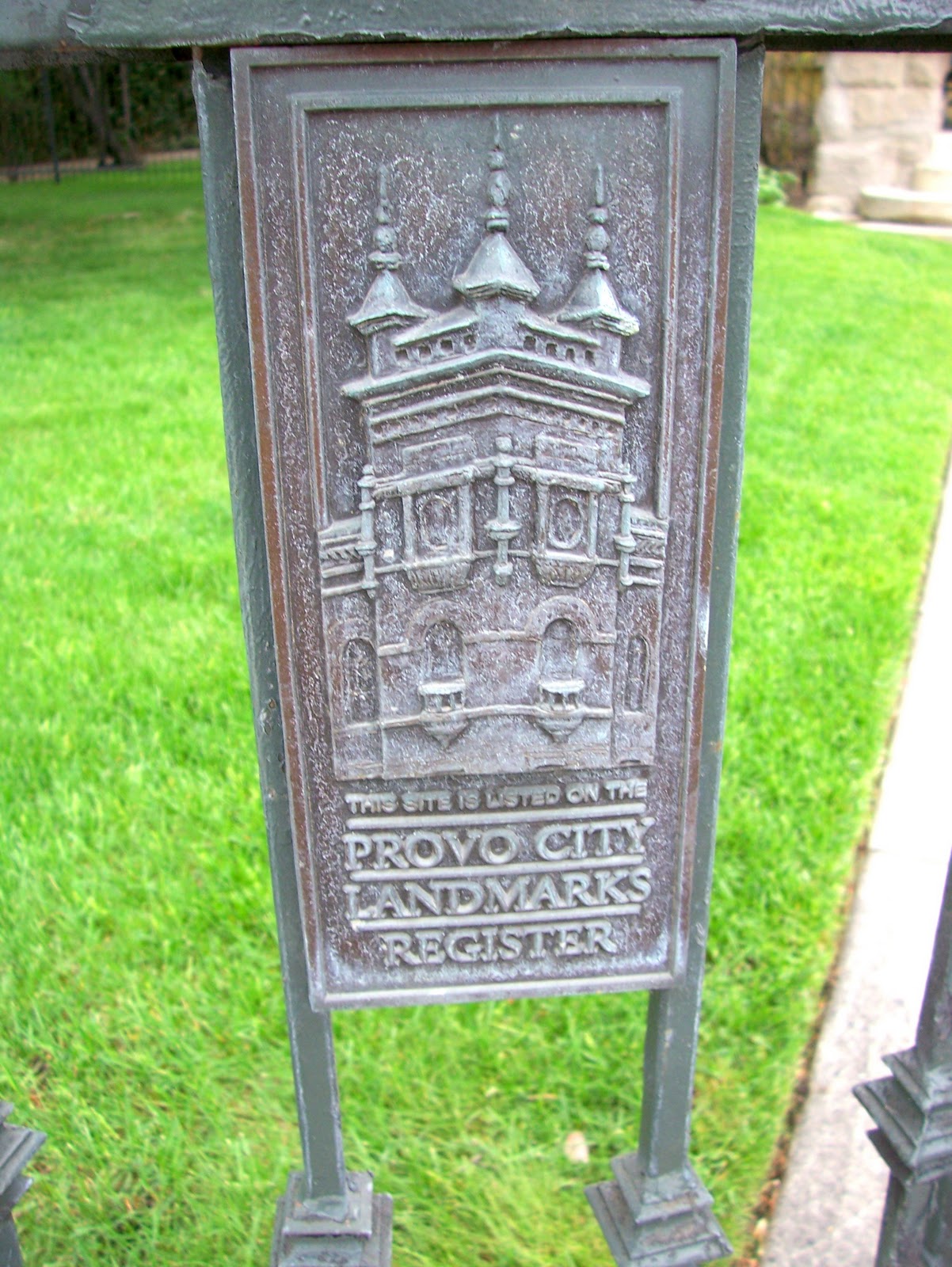
The house was constructed in 1905 and is built in the Colonial Revival Style , although one place I found said that it is actually neo-Classical.  It was added to the National Register of Historic Places in 1982 and was designated to the Provo City Historic Landmarks Register on June 19, 1996.  Currently it is home to the Berg Mortuary.

Sunday, October 16, 2011

Provo Center Street, Part 1 of many...

     The coolest and most historic residential area of Provo is by far Center Street.  There are some really amazing houses in this area, mostly between University Ave and around 700 East.  Over the next couple of posts I want to focus on some of these amazing buildings.

     The first one up for today is the Knight-Mangum House, which is located at 381 E Center Street in Provo.  Probably the best description regarding the history of the house is found directly on Wikipedia and most of this entry will be a direct quote from that site.  First though, here is what the house looked like probably around the time it was built and what it looks like today.  I think that the trees that are in the original picture are the same trees that are found in the current picture.  Also, since it is hard to see the house through all the trees, I added a picture of the house from the front:

Image courtesy of the J. Willard Marriott Library, University of Utah 


     "The Knight-Mangum Mansion was built in the old English Tudor style, completed in 1908. It was built for Mr. W. Lester Mangum and his wife Jennie Knight Mangum. Mrs. Mangum was the daughter of the famous Utah mining man, Jessie Knight. The lot was purchased for $3,500 and the home was built at a cost of about $40,000. The Mangum family was able to afford the home due to the fact that they had sold their shares in Jessie Knight's mine located in Tintic, Utah, for eight dollars a share. They had purchased the shares for only twenty cents a share, so the excess allowed them enough funds to purchase the home."


     The wikipedia article had a really interesting piece on Jesse Knight: 


     "The successful commercial mining of precious metals and minerals transformed Utah's economy from basically an agrarian base to a more industrialized state. Within this development the Tintic Mining District (I did several posts on this area.  To learn more about it, click here, here , here , here, here, or here) located approximately thirty miles southwest of Provo, was founded in 1869 and by 1899 became the leading mining center in Utah with a value of output placed at five million dollars. A central figure in Tintic success was Jesse Knight and the Knight family who resided in Provo. Jesse Knight attained wealth with his Humbug mine in the mid-1890s. The large silver producer allowed Knight to develop other mines in the East Tintic area. Knightsville grew around the workings and became touted as the only saloon-free, prostitute-free, privately owned mining camp in the U.S. His strict adherence to doctrines of the LDS church made the town one inhabited primarily by Mormons.


     "Jessie Knight was able to expand farther than the Tintic mines, reaching to the power plant in Santaquin, the Tintic drain tunnel project, the Knight Dry farm, and the smelters at Silver City.  The Bonneville Mining company, the Knight Woolen Mills, Ellison Ranching Company, the American-Columbian Corporation, the Springville-Mapleton Sugar Company, the Spring Canyon Coal Company, Utah Savings Bank, the Layton Sugar Company, and the Tintiv Drain Tunnel Company all represent facets of the Knight Investment Company."


     The article concludes with the current state of the house:


     "After the death of Mr. Mangum in 1949, the home was sold to Paul Salisbury of Salt Lake City who divided the home up into eleven individual apartments.  In 1969 Mr. Milo Baughman, one of America's leading furniture designers and present chairman of the Environmental Design Department at BYU, acquired the home.  It is now used primarily for office space.... The Knight-Mangum mansion was designated as a historic landmark of the city of Provo on April 28, 1995."


     I don't know how much of the concluding paragraph is accurate.  I believe that the house is currently being used as apartments, not as an office space (but I think there are only 4 or 6, not 11).  In fact, I have heard that the building is split up really awkward and that it is kind of a weird place to live in.  Ultimately, if it is a weird place to live in, it is at least a pretty cool place to look at.


     I talked to a guy in Provo who mentioned that he wanted to buy the Knight-Mangum house and restore it to how it used to look.  I would totally support that.  It is an awesome house, but without the contrasting white paint that it used to have it looks quite scary.  It is a little too dar with all of the greens, browns and grays in addition to the monstrous trees and bushes that are everywhere.  However, even with its scary presence, it is still one of the coolest houses in Provo.

Sunday, October 2, 2011

Duct Tape Version of the University of Utah's Rice-Eccles Stadium

     I wanted to throw out a recent art project that I did for the "Paint the Town Red" project.  Paint the Town Red is a local competition sponsored by the University of Utah and the Salt Lake City Downtown Alliance that tries to get local businesses to decorate their shops in support of the Utah Utes.  I decided that this would be a perfect time to do another tape art project, similar to one that I recently did of the Salt Lake City skyline.  This time I did the Rice-Eccles Stadium where the University of Utah Utes football team plays.  I did the piece of the side of Vosen's Bakery at 249 W 200 S in Salt Lake.  It is a cool shop and if you like local bakeries, go check it out.  Rather than using painter's tape like the Salt Lake City skyline piece, this project was done using only red and white duct tape.

     Hope you enjoy!

Friday, September 16, 2011

Should a Mormon Apostle be a US Senator?

     The other day I concluded reading one of the most interesting books on early Mormon politics called The Politics of American Religious Identity: The Seating of Senator Reed Smoot, Mormon ApostleReed Smoot was elected to the United States Senate in 1903.  However, at the time he was an apostle for the Church of Jesus Christ of Latter Day Saints, which will be referred to as the LDS Church.

     This election was extremely controversial because many in Washington D.C. felt that Smoot's election was the LDS Church trying to control the political arena in Utah.  Further controversy arose due to the continued practice of polygamy, even after the LDS church stated that they discontinued it (while I understand that this can be a contentious point for several people.  This is at least what the book argues).  Many in D.C. felt that Smoot may himself be a polygamist in addition to hostilities between Mormons and Protestants.  This resulted in several members of the Senate refusubg to seat him.  A huge trial commenced, called the Reed Smoot Hearings, which I believe has the largest collection in the US Library of Congress of trial evidence of any trial in US history.  It was a big deal (and is a really interesting read).  Here is a comic of the Smoot Hearings:

Courtesy of Wikipedia

    Smoot was eventually seated in the Senate despite several objections from fellow senators.  He ended up serving in the senate till 1933 and was a very influential and powerful member.  The whole story is a very interesting, and I feel not a well know part of US and LDS history.

     Smoot has a strong connection to Provo, Utah, and his house is located near downtown at 183 E. 100 S. (it is on the corner of 200 E and 100 S).  Smoot lived there from  1892 until his death in 1941.  The house is National Historic Landmark list;  there are only 15 places in Utah that are on the list, including Ft. Douglas, Temple Square, and the Brigham Young House.  It is also the only located on the list in Utah County.  The list is pretty exclusive and quite an honor for the house to be there.

     Here is a picture of the house at some time when Smoot was living in it (he is located on the far right in the top picture) and what it looks like today:

Courtesy of the J. Willard Marriott Library, University of Utah


     The plaque on the front of the house reads: "This house was built for reed and Ellie Eldredge Smoot [his wife who is in the picture above] in 1892.  Richard K. A. Kletting was the architect.  Reed Smoot, born in Salt Lake City in 1862, served as a member of the Quarum of the Twelve Apostles of the LDS Church from 1900 until his death in 1941.  Senator Smoot represented Utah in the United States Senate from 1902 [although this date is controversial, since he wasn't seated until later] until 1933 and became a national leader of the Republican party.  Reed Smoot was the son of Abraham O. Smoot, pioneer, civic, business and Mormon church leader."  The house is still owned by relatives of Reed Smoot and some of his descendants work and live in the Provo area (I met one while researching another blog entry).

    The history surrounding Smoot is extremely interesting, and his legacy is a great addition to Provo.  To answer the question in the title, although the LDS church does not encourage Apostles to be Senators (and I think they may have just come out and forbidden it) in the 1900's the situation was different and they did encourage an Apostle to become a Senator from Utah.  I encourage anyone who has a little bit of time to read a little bit more about Reed Smoot.  Below are a few additional pictures of the house:


     I have to add one additional photo.  I love the neighborhood surrounding the Smoot House and feel that it is one of the best in Provo.  Also the orange house below was an inspiration for my sister's own house which she painted orange.  I thought that I'd add a photo of those as well.  Here they are:

Thursday, September 1, 2011

The Provo Mayor's House

     Today I wanted to continue with a historic home near the McCoy home.  Today's focus is known as the Ray House and is located at 415 S University Ave in Provo.  It is a beautiful house that I have always been interested in.  Also, I heard a rumor that it was once the designated house for the elected Provo mayor.  Here is what it looked like in the 1970's and what it looks like today:

Photo courtesy of provo.org


On Wikipedia, it states that William Ray (after who the house is named) was "born on December 30, 1864 to William and Martha E. Ray, in Gentry County, Missouri. WIlliam H. Ray grew up on a farm. After becoming certified as a teacher, Ray worked in Iowa, Kansas, Nebraska, before settling in Salt Lake in 1890. Once in Salt Lake, Ray worked as a car inspector for the Union Pacific Railroad and then the Oregon Short Line Railway Company, and in addition to this invested in real estate. 'In spite of limited salary from the railway company and therefore limited investment funds, in a period of five years he had advanced to become the senior partner in W. H. Ray Company, the largest real estate business in the area (Provo City Library p. 1).' In 1894 William H. Ray married Lottie L. Chappell, and had six children. Ray was a member of the Provo Community Congregational Church. Ray died on October 31, 1936 and was buried in Provo." 

The house is currently on the National Register of Historic Places.  The plaque on the front of the house reads, "The William H. Ray house, built c. 1898, is historically significant for its association with William H. Ray, an important turn-of-the-century entrepreneur in Provo.  He was a financier, banker, broker, and mayor of Provo.  The Ray House, which was probably designed by Richard C. Watkins, a prominent Utah architect, is architecturally significant as the most distinctive Provo example of the influence of the Romanesque Revival style on residential design."

On important achievement of Ray is that he was one of the founding members of the State Bank of Provo.  I had never heard of this bank so I did a little investigating.  The State Bank of Provo merged with the Springville Banking Co. in 1966 and became the Central Bank and Trust (the focus of another blog entry that I did), which was at the time the largest bank in Utah County.  The best information about the State Bank of Provo can be found on the Central Bank's website.  The State Bank of Provo was formed in 1902 by a random group of 16 men.  The bank prided itself on personally knowing every one of its customers.  It continued to grow after its start until its merger in '66.

I don't think that this house was ever the house for the elected mayor of Provo.  I believe that the rumor probably began because it was the house of the Provo mayor for a time, when Ray was the mayor of Provo.  The house is currently divided and used as several different apartments.

Here is one additional view of the house: