Monday, January 21, 2013

University and Center: Provo's Most Dangerous Intersection

Historic photo courtesy of Brigham Young University, Lee Library, L. Tom Perry Special Collection

In April of 1917, a group of artisans in Provo decided to add an innovative, concrete fountain to the intersection of University Ave and Center Street.  The fountain marked what became a meeting place for Provo residents; several community events were organized and held around the fountain, including bike races, hikes, and pageants.  The fountain was eventually removed in 1931.

The Daily Herald wrote an excellent article about the fountain.  One of my favorite stories recounted in the article is how the fountain was used to "duck," or throw people in the fountain, several Provo High School students who did not show up to a mandatory day of service.  I also enjoyed the story about a group of kids who would hold onto car bumpers in the intersection and get a quick ride down the street.

The fountain was eventually moved because it was a traffic hazard.  Automobile accidents were extremely common around it, especially in the winter time when the fountain froze over and the ice spilled onto the street.  Since University Ave is a state highway, the state offered to remove the fountain.  Although several individuals wanted to move the fountain to a local park as a commemoration of the horse and buggy era, the city accepted the states offer when no funds could be found to move the fountain.

Below is an additional photo of the fountain looking towards the east.

Historic photo courtesy of Brigham Young University, Lee Library, L. Tom Perry Special Collection

In the first photo of this post, you can see one of the most prominent buildings in Provo, the First National Bank Building (which may be known as the Commercial and Savings Building), which is currently part of Provo Town Square.  Below is a picture of the building from 1880 and what it currently looks like.
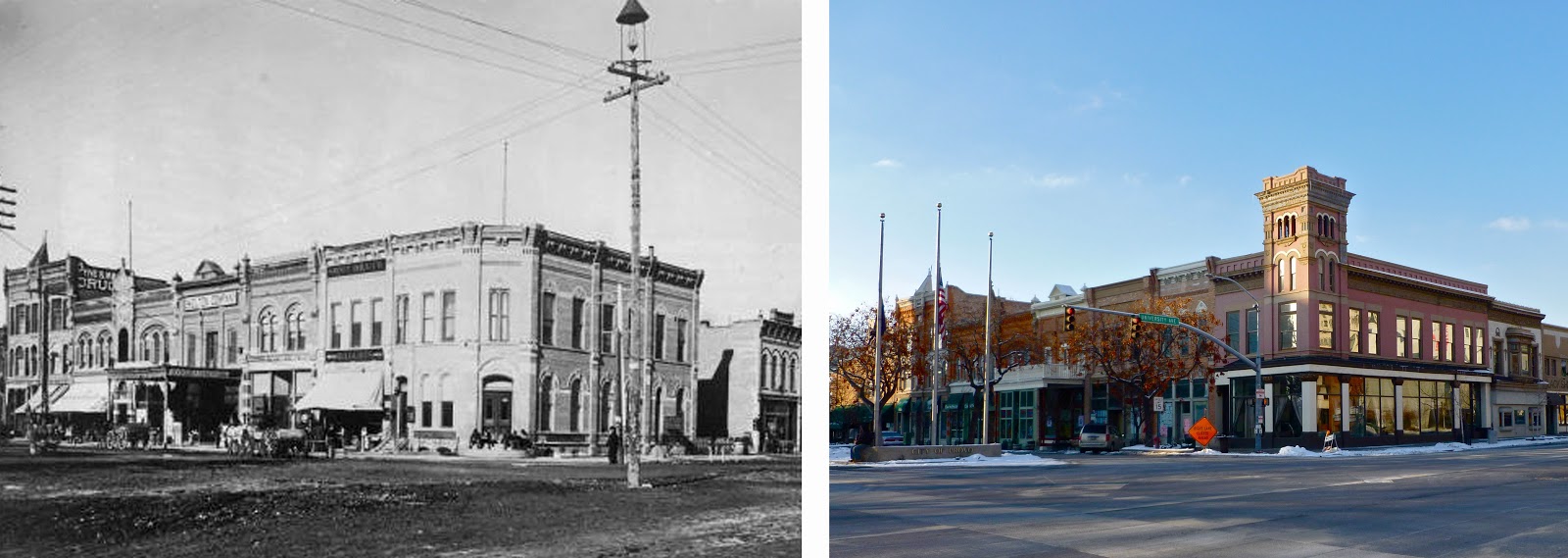
Historic photo courtesy of Brigham Young University, Lee Library, L. Tom Perry Special Collection

The Provo City Website has an excellent summary about the history of this building.  It reads:

"Businessmen A. O. Smoote organized the First National Bank of Provo in 1882 and constructed their first building on this site in 1884.  In 1894 the Provo Commercial and Savings Bank took over First National.  Reed Smoot, president, had organized the new bank in 1890.  Provo Commercial and Savings constructed this building in 1904.  Like the Knight Block, the architect for this building was Richard C. Watkins.  Watkins also designed College Hall and other commercial buildings on University and Center during the real estate boom in Provo at the turn of the century.  The new bank resembles the Knight Block and is late Richardson Romanesque-Commercial.  The ground level has been altered, eliminating the large arched window.  Look especially for the capitals on the free standing and engauged columns.  They have some of the finest hand carved masonry work in provo.  The carving which are also are Richardson Romanesque inspired, included Gothic creatures and naturalistic designs such as leaves.  The second level has remained essentially intact."

As nerdy as it sounds, I got really excited when I read that the building is in the Richardson-Romanesque style because my favorite building in Salt Lake, the City and County Building, is also Richardson-Romanesque.  One additional historical note is that the first building at this site held class for Brigham Young Academy after the Lewis Building was destroyed in 1884.

Below are a couple of additional photos of the building throughout the years.

Photo courtesy of Brigham Young University, Lee Library, L. Tom Perry Special Collection


LOST IN HISTORY:  The other day I read about a building in Provo that has been lifted off its foundation and is resting on stilts about 5 feet of the ground so that a 38 foot basement can be dug.  Which building is it?  As a couple extra hints, it is located in the vicinity of the First National Bank Building and it has been covered in a couple of previous posts.  If you would like to see pictures of it rest on stilts, take a look at the Skyscraperpage Forum.

Sunday, January 13, 2013

The Old Provo High School


I came across a blog a while back that photoshopped photos of Russian cities with the same location as it appeared during World War II.  I loved the idea and wanted to incorporate it into my blog.  I am going to start each of my blogs with a photo in the same style.  Above a picture of the old Provo High School, which is the currently location of the Provo City Hall.

On the corner of 300 West and 100 South, where the fire station is located, there is a plaque commemorating the old high school.  It reads:

"August 20, 1812, the Board of Education agreed 'that a high school be established in Provo city.'  The so-called high school began with 'one year' then 'two years' and then more until it became a four-year school.  At the close of the school year of 1920-21, Provo graduated students from the public high school for the first time in the city's history.  A high school yearbook of 1918 lists the names of eight students who were in the eleventh year.  The ten-year period, following the close of World War I, was a time when the high school grew rapidly.  In the spring of 1924, there were 65 graduating students, and at the close of the school year of 1924-25, one hundred-sixteen pupils graduated.  By 1956 more than 1,000 students attended school at Provo High School.  The last graduating class of 1956 had 336 students.  More than thirty-five class groups emerged into life from this edifice."

The high school was eventually moved to the corner of University Ave and Bulldog.  After the school was moved, the original building was demolished and replaced with the Provo City Hall, which includes the main police and fire station.  Below are pictures of what the school looked like after construction and what it currently looks like.

Photo courtesy of Brigham Young University, Lee Library, L. Tom Perry Special Collections

Photo courtesy of Brigham Young University, Lee Library, L. Tom Perry Special Collections

LOST IN HISTORY:  There is only one building from the original high school that still stands.  What is this building?  As a hint, it is located on the corner of 300 West and 100 South and two pictures of it are below (if you want to figure it out yourself, do not look too closely at the second photo, where the name of the building can be found).


Saturday, January 5, 2013

An Opera and a Beer in Provo

There has been a lot of talk recently in Utah news about the new performing arts center that will soon be coming to Salt Lake City and even the possible relocation of the Hale Center Theatre from West Valley City to Sandy.  With all of the talk about performing arts, it is interesting to note that Provo used to have one of the premier Opera Houses along the Wasatch Front.  The Provo Opera House was located about 50 North 100 West.


Provo: the garden city of Utah: its resources and attractions stated about the opera house, "Perhaps no other city of double its population in the United Sftates has so fine a building of amusement as Provo.  The Provo Opera House has a seating capacity of 900, and cost over $30,000.  Like all other public institutions in Provo, everything is new and contains all the modern advantages in the line for which it was erected.  It may be unnecessary to state that a city with such a building has a good record among traveling theatrical companies for the number of its amusement-loving inhabitants."

The best information that I could find on the Opera House was from the BYU website where the picture was originally published.  The site states, "Although plays, debates, and lectures were held in College Hall, the old Opera House in downtown Provo (constructed in 1888 on First West between Center Street and First North) was the scene of many large-scale BYU productions, such as operas and major drama, before 1920.  Later the seats were removed and the building was used for dances and boxing and wrestling matches.  According to Professor J. Homer Wakefield, who took this photograph, it was the site of Jack Dempsey's boxing debut.  In the 1920s it was converted to a National Guard armory, and it was razed in the 1950s."

Who can enjoy a good night at the opera without a large drink of beer?  Well, for those lucky opera goers, the Palace Saloon was located directly across the street.  There is a complete lack of information about the Palace Saloon on the internet.  In fact, when googling "Palace Saloon Provo," only six results were provided, five of which were photographs from photo databases.  The Palace Saloon was located on the west side of 100 West between Center and 100 North.  What surprised me even more than the lack of information on the internet is that the building is still standing, just to the south of where Sammy's is located.

 Courtesy of Brigham Young University, Lee Library, L. Tom Perry Special Collection

Sorry the above picture is such poor quality; I promise that it isn't from the 1970's.  For some reason, I didn't take a picture of the building face on and had to use the picture from Googlemaps.  Below is a better picture of what the building currently looks like.


One of the pictures that I came across while researching the Palace Saloon was a great flicker account in which old historic buildings are combined with modern pictures of the same building.  Here is the picture I found.  If you want to look at some more buildings in downtown Provo, check out chisbateman's photostream.


LOST IN HISTORY: Time for the second installment of Lost In History, an interactive part that I am going to include and the conclusion of the posts to help the blog be more interactive.  Once again, if you have any comments or ideas for rewards or giveaways that could be given to the first person who responds, let me know.  For todays Lost In History, I thought that the lack of information about the Palace Saloon was unfortunate.  However, it reminded me of perhaps the biggest connection that Provo has to saloons.  Provo's most notable resident around the turn of the 19th century was an individual who was famous for having the only "saloon-free and prostitute free" mining camp in the US.  Who was he and what connection did he have to Provo?  To help you out, he did built several houses around Provo which have been featured in previous posts, and as an additional hint, his name is on the most notable historical business building in Provo.

Saturday, December 29, 2012

Doing A Little Historical Searching Yourself...

I recently came across a couple other pictures of historic buildings around Pioneer Park in Provo.  The first is of the Provo Foundry and Machine Company.  Here is a picture of the old building from 1908 and the 1930's:


This building used to sit on the corner of 500 West and Center Street, right where the Fresh Market (previously Albertsons) parking lot is.  I found a really interesting book called Provo: The Garden City of Utah: Its Resources and Attractions.  It was published in 1888 by the Provo Chamber of Commerce as a means of informing people as to what Provo had to offer.  About the Provo Foundry it reads:


"It should be stated here also that the largest operating company for the manufacture of machinery and the working of brass and iron in Provo city, is the “Provo Foundry and Machine Company,” of which an organization was effected in January of 1886…. The main building occupied by the works of the company is 80x32 feet.  It is two stories high and is built of adobe and brick.  A commodious moding room in the rear of the building is 60x40 feet, besides engine rooms and shops which are usually constructed of such works.  The company has all the latest and most improved machinery—planers, turning lathes, power drills, and furnaces necessary for brass and iron casting, and the baking of cores for hollow iron works, with wide capacity, and facilities which do not include those used in the manufacture of machinery.  At present, but a limited number of workmen are employed by reason of the heavy cost of pig iron now imported from the east.  This difficulty will, however, be overcome at no distant day, as the company heretofore mentioned, which has in its possession the largest iron beds in the country, but a few miles from this city, contemplate the erection of furnaces for the manufacture of pig iron as soon as possible.  The foundry company has been thoroughly successful in its work, and is daily turning out machinery and castings fully equal to those produced by eastern institutions of a like kind."

I had a very difficult time finding any information about this building or company.  I believe the company was owned by a man with the last name Pierpont, who built and owned several of the homes around Provo.  The Foundry produced heating and plumbing pieces, many that are still being used in houses around Provo.  Although the second photo is from the 1920's or 30's, I do not know when the building was finally demolished.

Around the corner from the Foundry at 630 W 100 N is a really cool row of buildings called the Silver Row Apartments.  Here is a picture of it from around 1900 and what it looks like now:


Wikipedia has a great article about these apartments.  It reads:

"Built in 1890, the Silver Row Apartments were very representative of the times in the state of Utah.  Row houses, such as these, were prevalent in the larger cities of Utah and represent much of the lower-income residential architecture of the time period.  Few of the these examples remain today, making these apartments a valuable and significant asset to the state of Utah's history.  The Silver Row Apartments were disgnated to the provo City Historic Landmarks Registry on April 26, 1996.

"The original owner of Silver Row was David P. Felt.  Felt was born in Salt Lake City in 1860.  After marrying Nora Civish, Felt relocated to Provo, Utah.  Silver Row was built by him about 1890."

There are a couple of other places in that neighborhood that I wanted to include.  Here is an image from 1900 of the Bullock House, which was located just west on the Foundry between 500 and 600 West on Center Street, where the Fresh Market parking lot that currently is located:


Below is the 3rd Ward LDS Assembly Hall, located at 500 W and 100 N in Provo.  The building is currently part of Discovery Academy, a residential treatment center.

Courtesy of the Provo City Library


Below is Center Street at 700 West, facing west.  These houses pictured in this photo can still be found at the location, although trees have grown along the sidewalk, completely obstructing the view:

Courtesy of Brigham Young University, Lee Library, L Tom Perry Special Collection

Finally, the Strickland Residence, which was located at on the Southwest corner of 500 West and 100 North.


I was originally confused about where the Strickland residence was located at.  I finally found some old maps labeled the "Sanborn Fire Insurance Maps."  I was able to find the residence on the Sanborn Fire Insurance Map #10.  Its octagonal shape was easily distinguishable on the corner or 500 W and 100 S, located just north of the Foundry.  Below is the image that I am talking about.


I really enjoyed looking at the Sanborn Fire Insurance Maps.  If you are interested in researching about downtown Provo, or any other cities in Utah such as Salt Lake or Ogden, I would recommend checking out the Insurance Maps.  The best place is to go to the Mountain West Digital Library and search "Sanborn Fire Insurance Maps."  You will have to be specific about what city you want because there are almost 2,000 results from multiples years from places like Ogden, Provo, Salt Lake, Milford, Lehi, and many others.

The map that I included above is from a set from 1900 which shows several of the buildings located around the downtown Provo area, from 600 West to 400 East and from and from 600 North to 700 South.  Several of the buildings are labeled, and some you can distinguish by the shapes of the building, such as the octagonal shape on the Strickland residence.  In the Maps Center Street is 7th (and 100 North is 8th, 100 South is 6th) and University is J or Main (I is 100 West, K is 100 East; as a reference if you ever look at any other old maps, you may see University Avenue listed as Academy Avenue).  I encourage you to do a little bit or research ourself and learn more about the historical buildings in Provo area, or really any area in Utah,  that may be of interest to you.

As a final note, even though there are a couple more posts about historical buildings in downtown Provo, this is the last post about historical houses in Provo.  As I was researching this, I came across an interesting blog about historical homes in Utah County called Utah Valley Homes.  I hope you enjoy it as well.

I wanted to start some type of trivia/riddle/interactive puzzle somewhere in each post to try to involve readers and get them interested and involved in history.  I decided to call it "Lost in History."  I would love to offer some type of prize of reward, but since I am a poor college student, I don't have anything.  I might try to collect stuff as I travel around Utah photographing places, so if you have any suggestions, let me know.  Also, let me know what you think about this new section and any suggestions or comments you may have.

LOST IN HISTORY: The most popular "Utah's Present History" post, by far, about Provo has been the one about the Utah State Mental Hospital.  Although the Hospital is not located in downtown Provo, it is part of the Sanbourn Fire Insurnace Maps from 1900.  There are 25 sheets altogether, coving all of downtown, and a little more.  Which sheet is the Mental Hospital located on?  As an additional hint, you may want to follow the directions above about finding historical buildings around Provo (look at the paragraph below the Sanbourn Fire Insurance Map picture)


Sunday, December 23, 2012

The Old Provo Library

When I think of historical buildings in Provo, one that immediately comes to mind is the Brigham Young Academy, which currently serves as Provo's library.  The Academy has only been used as the city library since 2001.  So where was Provo's library located before 2001?

According to Wikipedia, the "Provo City Library was founded in 1905.  It first opened in the basement of the Provo City courthouse in October of that year and operated until 1908.  During its operation in the courthouse, it acquired 1,423 books donated by individuals in the community.  Soon after that, the collection doubled to 3000 volumes by April 1908.  On December 1, 1908, the library moved into a new building provided by a grant of $17,500 from Andrew Carnegie.  Over the years, the library grew in size, by obtaining approximately 65,000 volumes and 125 periodical subscriptions.

"In 1989, the library moved to another location, the City Center Building.  Although it was bigger than before, it became inadequate within a couple of years.

"In February 1997, a $16 million library bond passed which allowed the library to move to a bigger location.  The bond helped preserve and renovate the historical Brigham Young Academy building.  On July 9, 1999, city officials broke ground to initiate renovations for the new library, and then on September 8 2001 the library began full operations."

The Carnegie Library that was built in 1908 was located at the Northwest corner of 100 East and Center Street.  This building was enlarged and modernized in 1939, which is why it currently has an art deco type look as compared to its original look.  The City Center building that the library moved to in 1989 was located at 425 W Center Street, the current location of the Covey Center.  Below are a couple of pictures of the Carnegie library from 1908 and what it looks like today:


Andrew Carnegie changed the library system across the United States by donating millions towards the construction of 2,509 libraries.  Twenty-three such libraries were built in Utah including the Springville Library which I previously did a post about.  If you would like to read more about Carnegie Libraries, check out this Wikipedia article.